Microchipping your cat—and keeping it useful
Microchipping provides permanent identification only when the chip is registered correctly and the contact record stays current. It does not track a cat's location.
 Topic illustration selected for this guide. Some learning images may be AI-assisted.
Microchipping your cat—and keeping it useful — the quick answer
✓ A microchip does not track location
✓ Register it immediately
✓ Update details after every move or number change
✓ Ask for a scan at routine visits
A microchip provides permanent identification, but it is not GPS. A scanner reads its number, which must lead to current contact details in the correct registry.
Turn implantation into identification that works
A chip is useful only when it can be detected and its registry leads to current contact details. Complete every part of the chain.
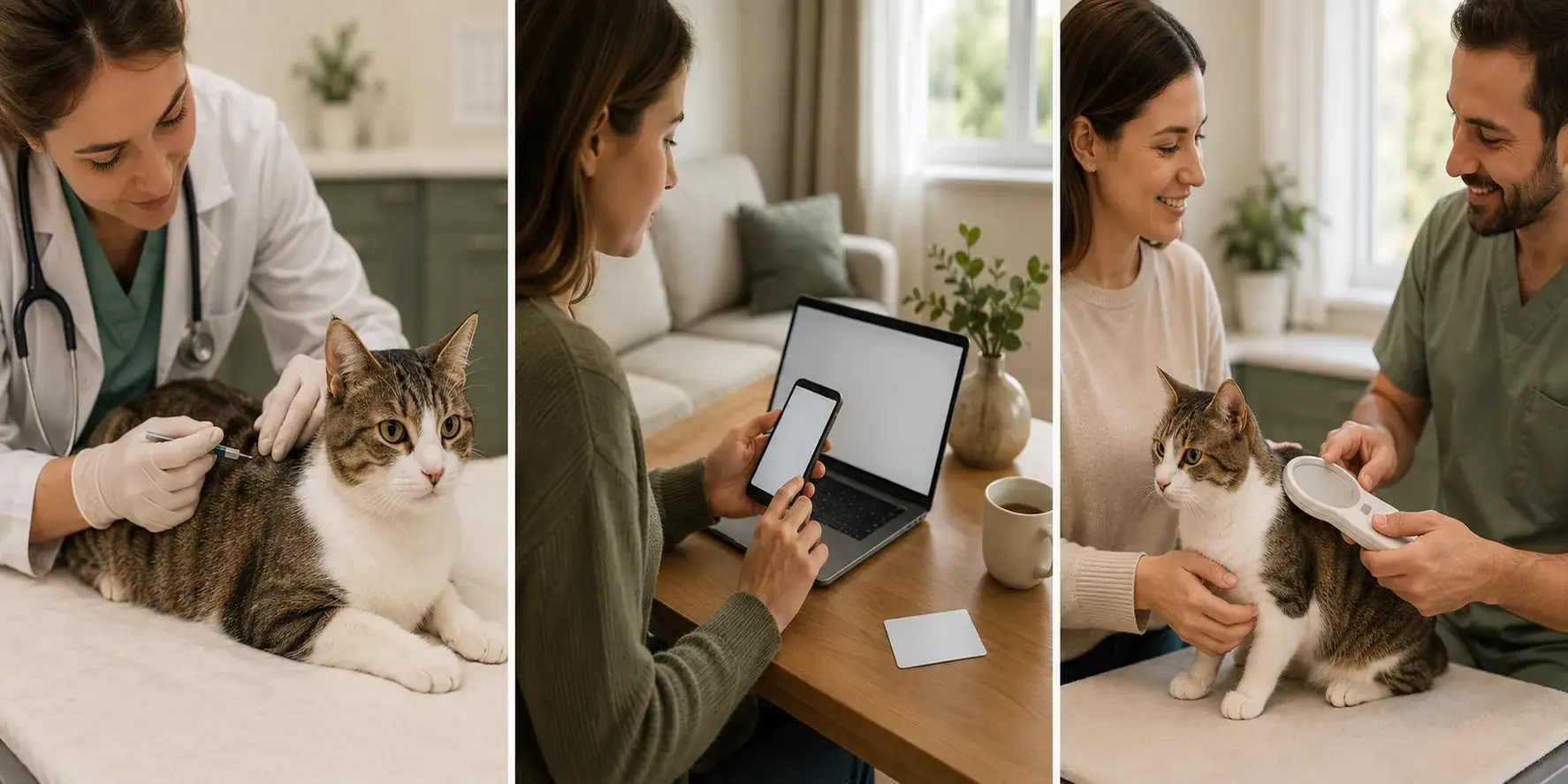
- 1Implant through a recognised professional
Ask a veterinary clinic or recognised service to implant the chip and give you the exact chip number and registry information.
- 2Register and update the contacts
Complete registration immediately, add a reachable backup contact and update the address, phone and email after every change.
- 3Request routine scanner checks
Ask the clinic to scan the chip periodically and confirm that the detected number matches the record you have saved.
What implantation does
A veterinarian or trained professional places a small identification chip under the skin. Shelters and clinics can scan it and use the number to search an appropriate registry.
Complete the registration
Keep the chip number, registry name and login details. Confirm that primary and backup contacts are correct and able to answer unknown calls.
Maintain the link
Update address, phone and email after changes. Ask the clinic to scan the chip periodically to confirm that it can be detected and the recorded number matches.
Use layered identification
A microchip complements—not replaces—a secure carrier, current photos and, when safe for the individual cat, a breakaway collar with visible contact information.
Complete registration, not just implantation
Ask the clinic to scan the chip after placement and record its full number. Identify the correct registry, create or verify the owner account and check telephone, email, address and emergency-contact details. Paperwork showing a chip number is not proof that the database registration was transferred or completed.
Make verification a regular habit
Have the chip scanned during routine veterinary visits and review the registry after moving, changing contact details, adoption or travel. Keep the number with veterinary and evacuation documents. Continue using secure carriers, windows and doors because a microchip cannot prevent escape. If the cat goes missing, notify the registry promptly and follow local lost-cat procedures.
Your quick checklist
Your progress is saved on this device.
Three simple things you can do
You do not have to change everything today. Pick one step that feels realistic, try it and see how your cat responds.
- 1Microchip the cat through a veterinary clinic or recognised service.
- 2Register the chip immediately and update phone, address and backup contact after changes.
- 3Ask for the chip to be scanned during routine visits to confirm it can be found.
Common mistakes
×Assuming implantation automatically registers owner details.
×Treating a microchip as real-time GPS.
×Forgetting to update information after moving or changing numbers.
Questions cat people ask
Does a cat microchip track location?+
No. It stores an identification number that a scanner can read; the registry links that number to current contact details.
Does microchipping hurt?+
Implantation is a brief needle procedure similar to an injection. Your veterinary team can explain comfort and timing for the individual cat.
Still looking for the right answer?
Search the full EverYes Cats encyclopedia with your own words — a symptom, food, behaviour, breed or everyday question.
Checked, dated and transparent
- Prepared by
- EverYes Cats editorial team
- Last updated
- 4 September 2026
- Source checked
- 4 September 2026
- Primary reference
- American Veterinary Medical Association ↗
We begin with the named reference, rewrite the information in plain language and add practical cat-parent steps. Urgent health statements are checked against veterinary sources. This guide has not been individually reviewed by a veterinarian unless explicitly stated. It provides education, not diagnosis or treatment.
How we choose and use sources →
Spotted something unclear or outdated? Tell us so we can review it.
Your answer helps us improve the cat encyclopedia.
Pollen, petals, leaves and vase water can all threaten a cat's kidneys.