Why does my cat suddenly hiss at someone it knows?
Hissing creates distance and usually signals fear, pain, surprise or overload—not spite.
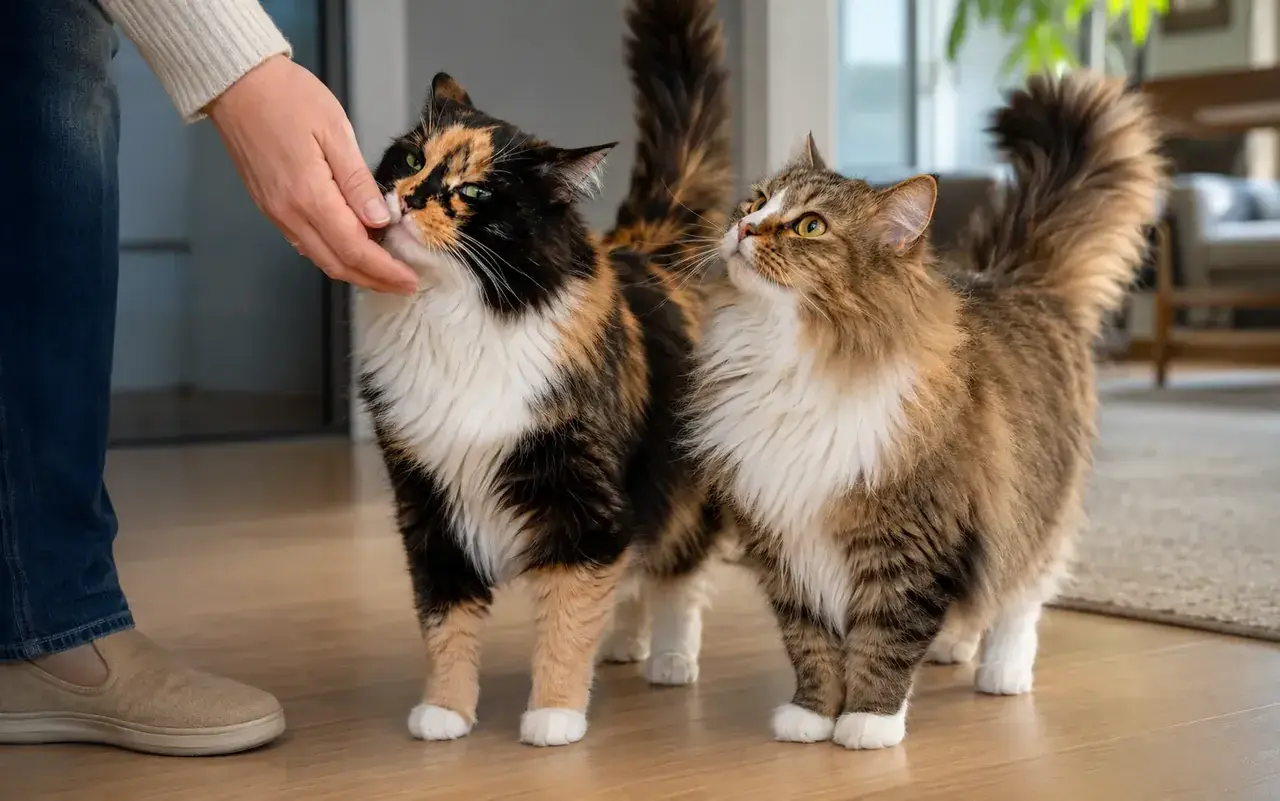 Topic illustration selected for this guide. Some learning images may be AI-assisted.
Why does my cat suddenly hiss at someone it knows — the quick answer
✓ Hissing creates distance and usually signals fear, pain, surprise or overload—not spite.
✓ Stop advancing, give an escape route and identify what changed before rebuilding contact.
✓ Repeated sudden hissing or sensitivity warrants a veterinary check for pain.
Hissing creates distance and usually signals fear, pain, surprise or overload—not spite. A familiar person can smell or move differently, approach a guarded resource or touch a sore area. Here is the useful version of the answer: what the behaviour may mean, what it does not prove and when it stops being just a fun cat fact.
The short answer
Hissing creates distance and usually signals fear, pain, surprise or overload—not spite. A single moment never tells the whole story, so compare the setting, the cat's posture and what happens next.
Why cats do this
A familiar person can smell or move differently, approach a guarded resource or touch a sore area. Cats combine scent, sound, sight, touch, memory and learning. That is why the same visible action can have more than one reasonable explanation.
Read the whole cat
Look at what changed just before the hiss: unfamiliar clothing or scent, a sudden reach, a blocked exit, another pet nearby or touch at a sore spot. Note whether the cat settles when given distance or remains tense and withdrawn afterward.
What to do at home
Stop approaching, make space and let the cat leave without being followed. Ask the familiar person to sit quietly and allow the cat to initiate contact on a later occasion. Do not scold, corner or offer a hand directly to a frightened face.
What this does not prove
This behaviour does not prove that every cat feels the same emotion or shares a human intention. Personality labels can be fun, but age, health, experience, environment and reinforcement explain much more than coat colour, sex or a single gesture.
When to contact a veterinarian
A sudden repeated hiss when touched, especially with hiding, reduced eating, limping or changes in grooming, calls for a veterinary assessment for pain or illness. Keep a short record of the circumstances instead of recreating the trigger.
Your quick checklist
Your progress is saved on this device.
Three simple things you can do
You do not have to change everything today. Pick one step that feels realistic, try it and see how your cat responds.
- 1Stop approaching immediately and give the cat a clear route to a familiar safe place.
- 2Check what changed: scent, clothing, movement, noise, location, recent handling or possible pain.
- 3Reintroduce contact at a distance with calm voice and valued rewards only after the cat settles.
Common mistakes
×Punishing the hiss, which removes an important warning without removing fear.
×Following or cornering the cat to prove the familiar person is safe.
×Assuming a sudden reaction is personal while overlooking pain or illness.
Questions cat people ask
Why did my cat hiss after I came home?+
Unfamiliar animal, clinic, perfume or outdoor scents can temporarily disrupt recognition. Change clothes if relevant, wash hands and let the cat gather information at its own pace.
Can pain make a cat hiss at someone it loves?+
Yes. A sore cat may defend space or react when it predicts touch. Sudden repeated hissing, hiding or touch sensitivity warrants veterinary assessment.
Still looking for the right answer?
Search the full EverYes Cats encyclopedia with your own words — a symptom, food, behaviour, breed or everyday question.
Checked, dated and transparent
- Prepared by
- EverYes Cats editorial team
- Last updated
- 21 September 2026
- Source checked
- 21 September 2026
- Primary reference
- International Cat Care ↗
We begin with the named reference, rewrite the information in plain language and add practical cat-parent steps. Urgent health statements are checked against veterinary sources. This guide has not been individually reviewed by a veterinarian unless explicitly stated. It provides education, not diagnosis or treatment.
How we choose and use sources →
Spotted something unclear or outdated? Tell us so we can review it.
Your answer helps us improve the cat encyclopedia.
A relaxed cat may continue purring while drifting into light sleep, especially during a warm, familiar resting routine. Purring alone does not prove comfort or deep sleep.