What a tail-up greeting means
An upright tail often accompanies a friendly or confident approach, but its meaning depends on movement, posture, facial expression and the surrounding situation.
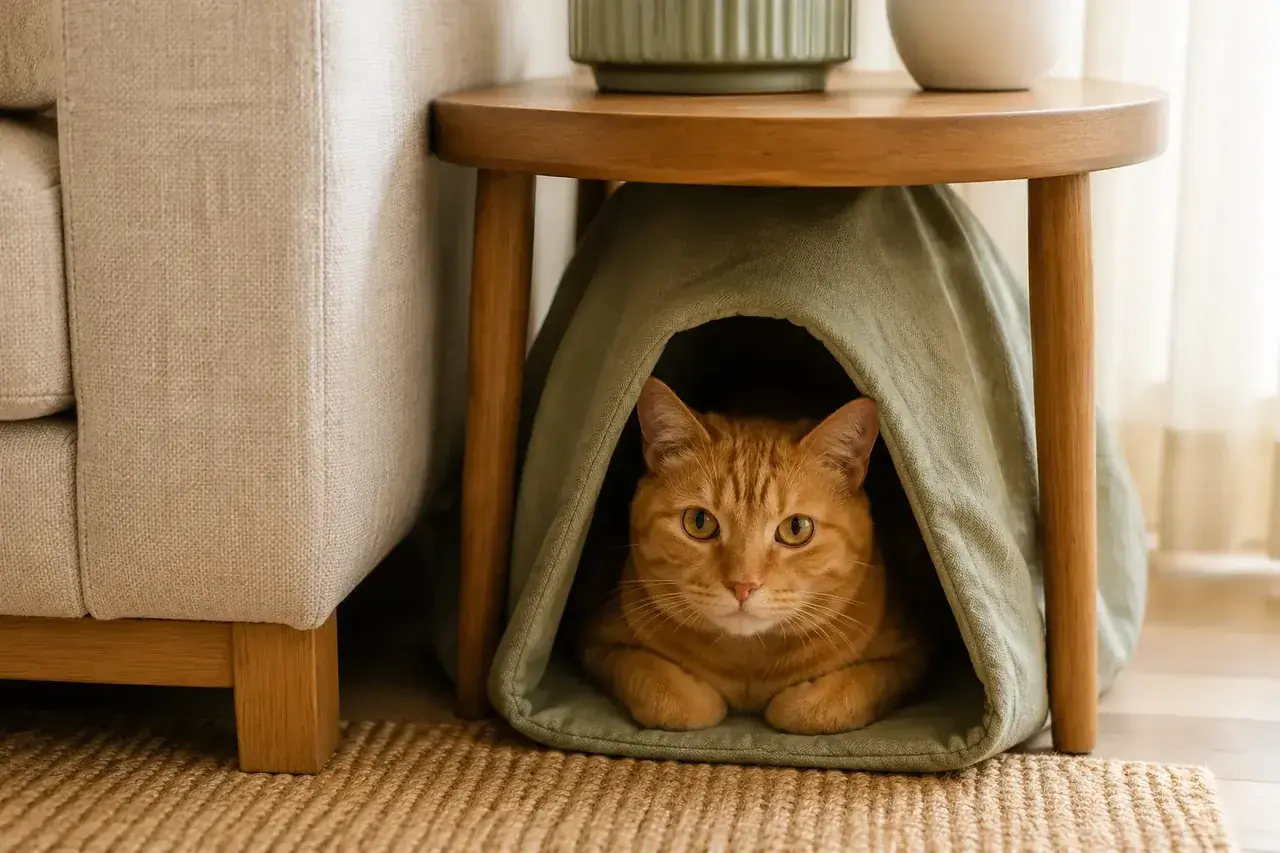 Topic illustration selected for this guide. Some learning images may be AI-assisted.
What a tail-up greeting means — the quick answer
✓ A relaxed vertical tail often supports friendly intent
✓ A hooked tip can accompany curiosity
✓ Puffed fur changes the meaning
✓ Let the cat choose the final distance
A vertical tail often appears during friendly approach and social greeting. It is encouraging, but it is still an invitation to observe—not permission to grab or over-handle.
Read the whole silhouette
Look for soft muscles, forward or neutral ears, normal-sized fur and an easy walking pace. A stiff body or puffed tail suggests high arousal instead.
Offer a low-pressure response
Turn slightly sideways, soften your gaze and offer a hand below nose level without advancing. Let the cat sniff, pass or rub.
Notice individual dialect
Some confident cats greet everyone tail-up; others rarely do. Compare the signal with that cat's normal behaviour and the current setting.
End before tolerance ends
Even a warm greeting can become overstimulating. Pause if the tail begins lashing, skin twitches, ears rotate back or the cat moves away.
Read the complete approach
A softly upright tail with a relaxed body, forward movement and neutral ears often signals social confidence. A quivering tail may appear during an excited greeting, while a rigid or puffed tail changes the interpretation. Watch whether the cat chooses to come closer, rub, pause or move away.
Respond without assuming consent
Offer a still hand or calm voice and let the cat decide whether contact follows. A friendly greeting does not automatically permit lifting, belly touching or prolonged petting. If the tail posture changes with crouching, staring, pain, spraying or sudden agitation, consider the full context and investigate abrupt behaviour changes.
Your quick checklist
Your progress is saved on this device.
Three simple things you can do
You do not have to change everything today. Pick one step that feels realistic, try it and see how your cat responds.
- 1Notice whether the upright tail accompanies soft eyes, relaxed ears and an easy approach.
- 2Offer a hand at a respectful distance and let the cat choose contact.
- 3Distinguish a relaxed upright tail from a puffed or rigid fear posture.
Common mistakes
×Reading the tail without the rest of the body.
×Grabbing or lifting the cat because the greeting looks friendly.
×Assuming a puffed upright tail means happiness.
Questions cat people ask
What does it mean when a cat walks toward me with its tail up?+
A relaxed upright tail commonly appears in friendly social approaches, especially when the rest of the body is loose and confident.
Why does the tip of my cat's upright tail curl?+
A gently curved tip can accompany a friendly or curious approach, but context and the complete posture matter more than one shape.
Still looking for the right answer?
Search the full EverYes Cats encyclopedia with your own words — a symptom, food, behaviour, breed or everyday question.
Checked, dated and transparent
- Prepared by
- EverYes Cats editorial team
- Last updated
- 4 September 2026
- Source checked
- 4 September 2026
- Primary reference
- FelineVMA Healthy Feline Environment ↗
We begin with the named reference, rewrite the information in plain language and add practical cat-parent steps. Urgent health statements are checked against veterinary sources. This guide has not been individually reviewed by a veterinarian unless explicitly stated. It provides education, not diagnosis or treatment.
How we choose and use sources →
Spotted something unclear or outdated? Tell us so we can review it.
Your answer helps us improve the cat encyclopedia.
One ear may independently track a sound, but persistent asymmetry can also reflect irritation or pain. Read the full body, try a gentle response and know when the change matters.