← Cat encyclopedia03
48 GUIDES
Body language
Eyes, ears, tails, posture and the subtle signals between them.
IN THIS LIBRARY
How to read cat body language
A tail, ear or pupil never tells the whole story alone. This hub helps you combine posture, movement, facial tension, sound and context so you can respond before uncertainty becomes fear or conflict.
START WITH THE SIGNAL YOU NOTICED
Six popular body-language questions
Use the focused guide as a starting point, then compare it with the rest of your cat’s body and situation.
AIRPLANE EARSWhat do ‘airplane ears’ mean in cats?
Uncertainty, irritation and listening in two directions
Read this signal →FLUFFED TAILWhy does my cat puff up its tail?Arousal, fear, surprise and playful excitement
Read this signal →ONE EAR BACKWhy does my cat turn one ear backward?Tracking sound while attention stays elsewhere
Read this signal →SHOWING THE BELLYWhy does my cat show me its belly?Trust, cooling, play or defensive readiness
Read this signal →START WITH YOUR QUESTION
What this topic covers
Read the whole cat
Compare ears, eyes, whiskers, tail, muscle tension and weight distribution. One isolated signal can be misleading without the rest of the body.
Notice change over time
A relaxed cat may become still, turn ears sideways, twitch the skin and move the tail before leaving. Earlier signals let you pause before escalation.
Respect distance-increasing signals
Hissing, growling, flattening and retreat are communication. Give space, preserve an escape route and investigate fear or pain rather than punishing the warning.
QUICK QUESTIONS
Important answers before you browse
What does an upright cat tail mean?+
It often accompanies a friendly greeting, but context, tension and the rest of the body still matter.
How can I tell if petting is too much?+
Watch for skin twitching, tail movement, ears rotating, head turns, muscle tension or attempts to move away, and stop early.
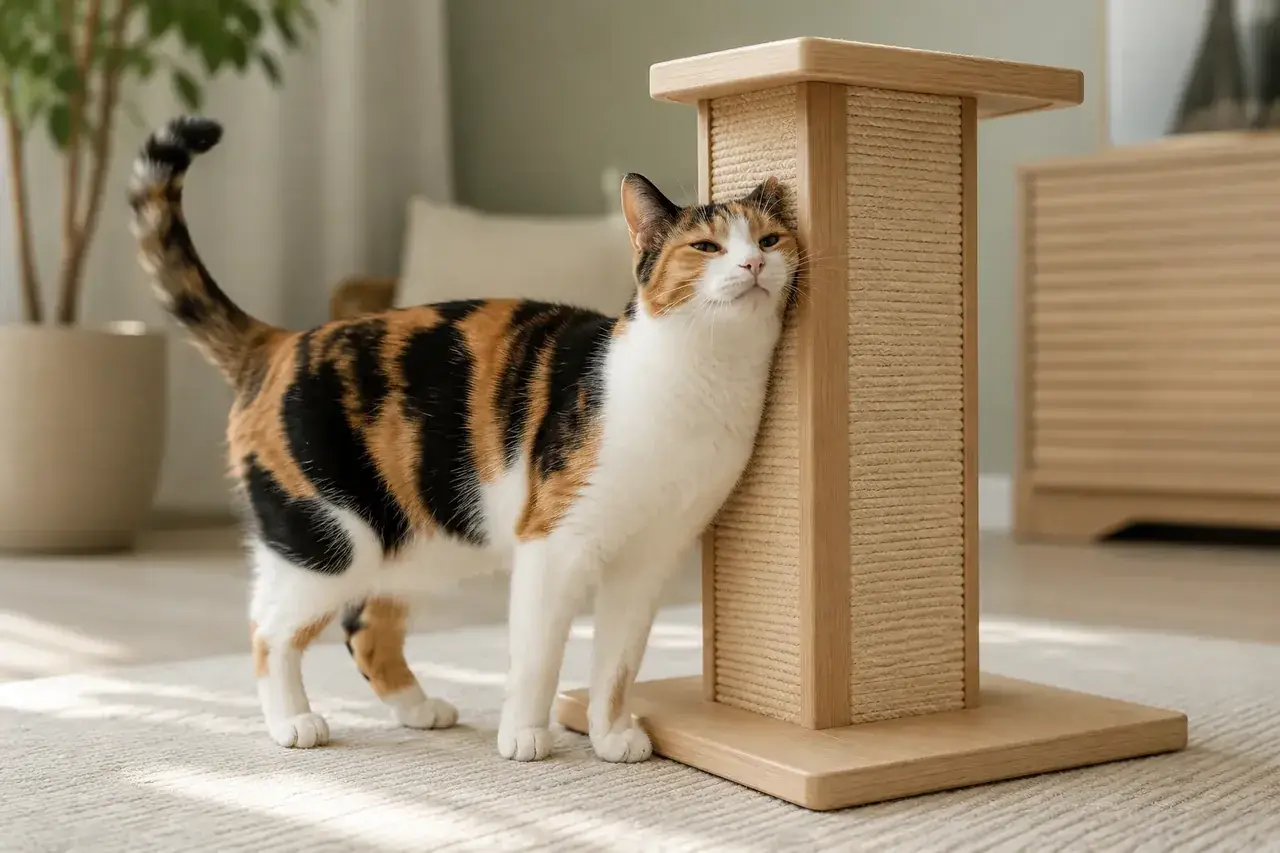
GOOD PLACE TO START · 8 min
Why does my cat chirp at their reflection?
A moving reflection can briefly resemble another animal or prey, while some cats simply investigate the visual change.
Read the guide →POPULAR IN THIS LIBRARY
See the complete library ↓Useful answers to start with
01 · 8 minWhy does my cat chirp at their reflection?Read guide →02 · 8 minWhy does my cat hold one paw up while watching something?Read guide →03 · 8 minWhy does my cat stretch when they greet me?Read guide →04 · 8 minWhy does my cat rub their cheeks on corners?Read guide →05 · 8 minWhy does my cat trill while walking around the house?Read guide →06 · 8 minWhat does it mean when a cat curls their tail around their feet?Read guide →
All body language guides
48 articles01
GUIDE · 8 min
→02Why does my cat chirp at their reflection?
A moving reflection can briefly resemble another animal or prey, while some cats simply investigate the visual change.
GUIDE · 8 min
→03Why does my cat hold one paw up while watching something?
A lifted paw often appears during focused hesitation, when a cat is deciding whether to step, retreat or pounce.
GUIDE · 8 min
→04Why does my cat stretch when they greet me?
A relaxed stretch can bridge rest and social contact while showing the cat feels safe enough to lengthen the body..
GUIDE · 8 min
→05Why does my cat rub their cheeks on corners?
Cheek rubbing deposits familiar scent and helps create a reassuring map of the home..
GUIDE · 8 min
→06Why does my cat trill while walking around the house?
Trilling can be a friendly contact call used during movement, greetings or invitations to follow..
GUIDE · 8 min
→07What does it mean when a cat curls their tail around their feet?
A wrapped tail often accompanies a compact resting posture, but tension elsewhere changes the meaning..
GUIDE · 8 min
→08Why does my cat look away after a slow blink?
Looking away can reduce social pressure and complete a calm, friendly exchange..
GUIDE · 8 min
→09Why does my cat curl their tail around their body?
A cat may wrap their tail around the body for warmth, comfort or protection. Decide whether the cat is cosy or cautious by checking muscle tension, ears, eyes and the situation—not the tail alone.
GUIDE · 8 min
→10Why does my cat trill before jumping up beside me?
A trill before jumping beside you is often a friendly greeting or attention signal. Upright tail, soft eyes and relaxed movement support that interpretation; voice or breathing changes need a health-first check.
GUIDE · 8 min
→11What does a silent meow mean?
A silent meow is often a normal greeting or request made at a frequency or volume people barely hear. A sudden loss of voice, noisy breathing, coughing or swallowing difficulty needs veterinary attention.
GUIDE · 8 min
→12Why does my cat rub against me and then bite?
Rubbing can be friendly while the bite that follows often means stimulation became too intense. Stop at the earliest body-language change and let the cat choose whether contact resumes.
GUIDE · 8 min
→13Why do cats lick each other’s ears?
Calm ear and head grooming between familiar cats can be social, but repeated attention to one ear may point to irritation. Observe both cats and inspect for physical signs.
GUIDE · 8 min
→14What does it mean when cats sleep together?
Cats sleeping in contact usually shows tolerance, familiarity or affiliation, but it does not prove that every part of their relationship is stress-free.
GUIDE · 8 min
→15Why does my other cat reject the cat returning from the vet?
A cat returning from the veterinarian may smell unfamiliar enough to trigger hissing or avoidance. Use temporary separation and a calm scent-based reintroduction instead of forcing contact.
GUIDE · 8 min
→16Are my cats playing or fighting?
Balanced cat play includes loose bodies, pauses, role changes and both cats choosing to return. Conflict is more likely when one cat repeatedly pursues while the other flees or cannot disengage.
GUIDE · 9 min
→17The petting consent test for cats
A petting consent test is simple: offer brief contact, pause and let the cat choose whether to re-engage. Absence of protest is not the same as consent.
GUIDE · 9 min
→18Why Does My Cat Turn the Ears Back When I Call?
The ears may track your voice behind the cat without showing fear; the rest of the body reveals whether the cat is relaxed. Read the full body, try a gentle response and know when the change matters.
GUIDE · 9 min
→19Why Does My Cat Move the Tail Tip While Resting?
A small tail-tip movement can accompany light sleep, attention or mild stimulation while the body remains relaxed. Read the full body, try a gentle response and know when the change matters.
GUIDE · 9 min
→20Why Does My Cat Pull the Whiskers Back While Being Petted?
Whiskers drawn back can accompany uncertainty or overstimulation, especially with tense ears and skin twitching. Read the full body, try a gentle response and know when the change matters.
GUIDE · 9 min
→21Why does the fur along my cat’s back suddenly rise?
Piloerection can make a cat look larger during fear, arousal or intense excitement. A calm, practical guide to what it means and what to do next.
GUIDE · 9 min
→22Why Does My Cat Hold One Ear Sideways?
One ear may independently track a sound, but persistent asymmetry can also reflect irritation or pain. Read the full body, try a gentle response and know when the change matters.
GUIDE · 9 min
→23Why Does My Cat Curve the Tail Around Me?
Wrapping or curving the tail can be a friendly contact gesture during a relaxed greeting. Read the full body, try a gentle response and know when the change matters.
GUIDE · 9 min
→24Why Does My Cat Crouch and Then Roll Onto the Side?
The sequence may shift from caution into relaxed play or a request for space, depending on the whole body. Read the full body, try a gentle response and know when the change matters.
GUIDE · 8 min
→25Why does my cat sit with their back to me?
A cat that sits with its back to you is often showing trust, monitoring the room or simply choosing a comfortable position—not rejecting you.
GUIDE · 9 min
→26Why Does My Cat Look Away Slowly During Eye Contact?
Turning the gaze away can reduce social pressure and help keep an interaction calm. Read the full body, try a gentle response and know when the change matters.
GUIDE · 8 min
→27Why does my cat chirp at me?
A chirp directed at a person is often a friendly greeting, request or excited transition sound. Interpret it together with posture and context.
GUIDE · 9 min
→28Why Does My Cat's Tail Puff Up Briefly During Play?
Excitement or surprise can raise the fur for a moment even during play, but sustained tension means arousal is too high. Read the full body, try a gentle response and know when the change matters.
GUIDE · 8 min
→29Why does my cat stare at me while using the litter box?
A cat may watch you in the bathroom because the routine is predictable, the room is interesting or your attention is easy to gain.
GUIDE · 8 min
→30Why does my cat lick their lips during brushing?
Lip licking during brushing can be a subtle stress, nausea or discomfort signal. Pause and read the whole body before continuing.
GUIDE · 8 min
→Why does my cat yawn when I approach?
Yawning may occur during relaxation, waking or a shift out of mild tension. Practical observations, a safe next step and clear warning signs.
COMPLETE LIBRARYShow 18 more body language guidesOpen +
31
guide · 6 min
→32Read the whole cat
Read clusters, not single signals. Ears, eyes, whiskers, tail, posture, movement, distance and context together reveal whether a cat feels relaxed, uncertain or overwhelmed.
guide · 8 min
→33Slow blinking: what the research can—and cannot—tell us
A closer look at relaxed eyes, context and respectful interaction.
GUIDE · 6 min
→34What your cat’s tail may be saying
A cat’s tail adds useful context, but it never works as a translation key by itself. Read tail height and movement together with ears, eyes, muscle tension, distance and the situation.
guide · 6 min
→35Fear signals in cats
Fear can appear as freezing, crouching, hiding, flattened ears, wide pupils or defensive behaviour. Increase distance and protect escape instead of reaching toward the cat.
guide · 8 min
→36What a tail-up greeting means
An upright tail often accompanies a friendly or confident approach, but its meaning depends on movement, posture, facial expression and the surrounding situation.
guide · 6 min
→37Play or fight?
Balanced play usually includes pauses, role changes and voluntary re-engagement. Conflict is more likely when one cat repeatedly pursues, blocks or corners another that is trying to escape.
guide · 8 min
→38Why a cat rolls onto the back
A cat rolling onto the back often shows comfort, greeting or playfulness, but it is not automatically an invitation to touch the belly.
guide · 6 min
→39Subtle signs of pain
Cats often show pain through small changes in movement, routine and social behaviour rather than crying. Compare the whole pattern with what is normal for that individual cat.
guide · 8 min
→40Why cats head-bunt and rub their cheeks
Head-bunting and cheek rubbing often deposit facial scent and can accompany greeting, familiarity or requests for interaction. Meaning depends on the whole body and context.
guide · 6 min
→41The three-second consent test
The three-second consent test helps you pause during petting and see whether a cat actively asks for more contact. It supports choice but does not make every touch comfortable.
guide · 8 min
→42Petting overstimulation: spot the early signs
Petting overstimulation often begins with subtle tension before a swat or bite. Shorter contact and frequent pauses help the cat retain control.
guide · 8 min
→43Spraying or peeing? Read the location and posture
Spraying usually marks a vertical surface with a small amount while the cat stands; ordinary urination typically creates a larger puddle on a horizontal surface. Both deserve investigation.
GUIDE · 6 min
→44Understanding cat scent marking
Cats communicate with scent through facial rubbing, scratching, urine and other signals. Friendly marking can make a home familiar, while new spraying or toileting changes need a different response.
GUIDE · 7 min
→45Read your cat’s ears and eyes
Read cat ears and eyes together with posture, muscle tension and context. Soft eyes and mobile neutral ears often fit comfort; flattened ears or a fixed stare mean pause and create space.
guide · 8 min
→46Why cats hiss
Hissing is a request for space, not evidence of a bad personality.
guide · 8 min
→47What whiskers pulled back can mean
Whiskers flattened toward the cheeks can appear with fear, discomfort or defensive tension.
guide · 8 min
→48Half-closed eyes: relaxed or painful?
Two softly narrowed eyes can show rest, while one squinting eye or facial tension suggests discomfort.
guide · 8 min
→Why does my cat freeze when petted?
Stillness is not always enjoyment; freezing can be a quiet coping response when a cat feels trapped.