Prevent door-dashing without frightening your cat
Door-dashing is safest to prevent with distance, barriers and a rewarding alternative station. Frightening or chasing the cat can make exits more chaotic.
 Topic illustration selected for this guide. Some learning images may be AI-assisted.
Prevent door-dashing without frightening your cat — the quick answer
✓ Use a second barrier whenever possible
✓ Reward a station away from the door
✓ Manage deliveries before opening
✓ Update identification in case prevention fails
The front door can predict smells, movement and attention. Punishment at the threshold can add panic; a trained station and physical management are safer.
Train a safe station and keep a physical barrier
Door safety should never depend on training alone. Build a rewarding place away from the entrance and manage every real opening.
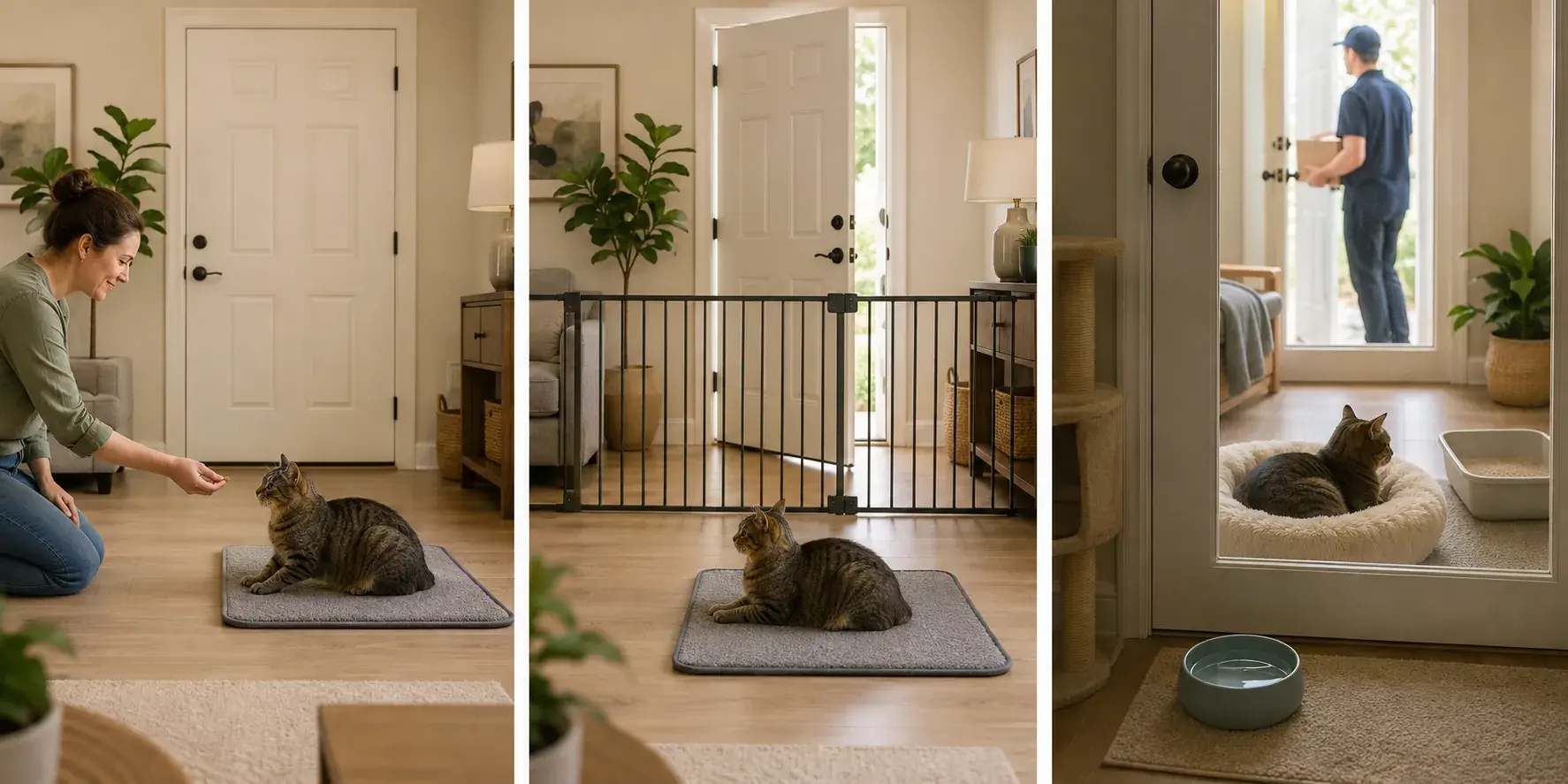
- 1Reward a station away from the door
Choose a mat or perch several metres from the entrance and reward voluntary use while the exterior door remains closed.
- 2Practise tiny door movements
Touch the handle and open the door only a crack while the cat remains at the station, with a secure second barrier protecting the exit.
- 3Manage real visitors first
Before deliveries or gatherings, place the cat in a comfortable closed room with essential resources instead of testing the training at an open door.
Change the traffic pattern
Place a mat, perch or treat station several metres from the door. Reinforce the cat for going there when you touch the handle, then when the door opens slightly.
Use real barriers
A closed interior door, tall gate plus supervision, or secure entry area protects during training. Do not rely on obedience when carrying groceries.
Prepare for visitors
Before deliveries or gatherings, place the cat in a comfortable room with resources. Add a visible reminder for household members.
Plan for escape
Keep microchip details and current photos ready. If a cat gets out, avoid chasing; reduce noise, open a safe return route when possible and use familiar scent and food strategically.
Change the doorway routine
Place a mat, perch or treat station several metres from the door and reward the cat there before touching the handle. Practise opening the door only a crack while another person or secure interior barrier protects the exit. Close it calmly when the cat leaves the station, then make the next repetition easier.
Add layers of physical safety
Use a porch, baby gate, screen door or closed room during deliveries and busy arrivals where practical. Keep microchip details current and ensure visitors understand the rule before entering. Never rely on training alone during moving, construction or emergencies. Provide secure outdoor access such as a catio if outdoor interest is strong.
Your quick checklist
Your progress is saved on this device.
Three simple things you can do
You do not have to change everything today. Pick one step that feels realistic, try it and see how your cat responds.
- 1Create a station several metres from the door and reward the cat for going there.
- 2Practise touching and opening the door a crack only while the cat remains at the station.
- 3Use a second physical barrier and current microchip identification during training.
Common mistakes
×Testing the behaviour at a fully open external door.
×Punishing or chasing the cat near the exit.
×Relying on training without a physical safety layer.
Questions cat people ask
Why does my indoor cat run toward the door?+
Novel scents, movement, learned attention and access-seeking can all contribute. It does not mean unsupervised outdoor access is safe.
Can a baby gate stop a cat?+
Many cats can jump ordinary gates, but a well-planned vestibule or second barrier can add valuable reaction time alongside training.
Still looking for the right answer?
Search the full EverYes Cats encyclopedia with your own words — a symptom, food, behaviour, breed or everyday question.
Checked, dated and transparent
- Prepared by
- EverYes Cats editorial team
- Last updated
- 4 September 2026
- Source checked
- 4 September 2026
- Primary reference
- FelineVMA Positive Reinforcement Training ↗
We begin with the named reference, rewrite the information in plain language and add practical cat-parent steps. Urgent health statements are checked against veterinary sources. This guide has not been individually reviewed by a veterinarian unless explicitly stated. It provides education, not diagnosis or treatment.
How we choose and use sources →
Spotted something unclear or outdated? Tell us so we can review it.
Your answer helps us improve the cat encyclopedia.
Give the cat control before the doorbell turns into a crisis.